Engine
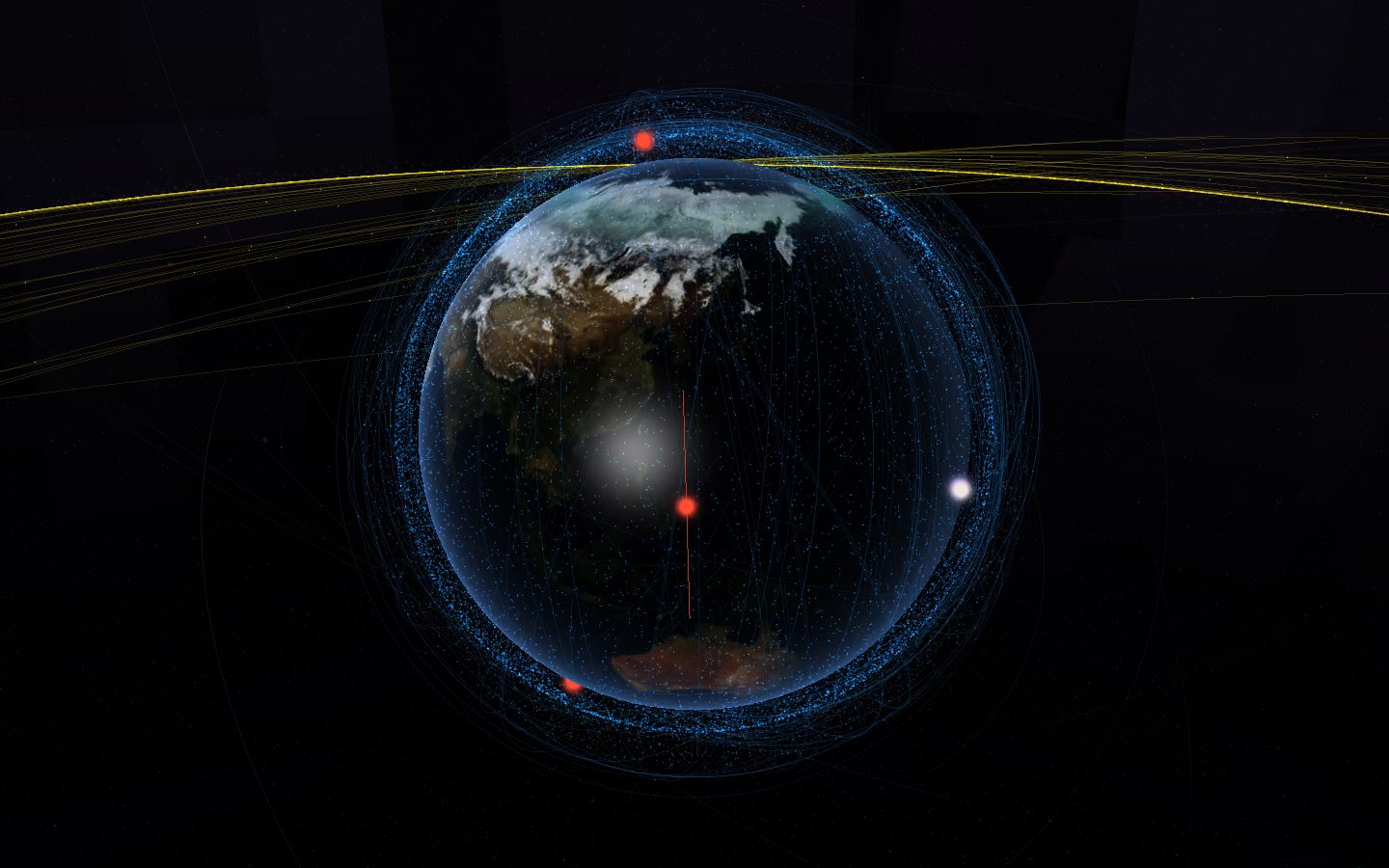
A real-time orbital engine, written from scratch in Rust and run on your graphics card through WebGPU.
- Download
- 221 kB
- WebAssembly over the wire, Brotli, measured on the live deploy (551 kB unpacked)
- Frame rate
- 60 fps at 50,000 and at 1,000,000
- an Apple computer, Chrome 153, 2026-09-29 (PERFORMANCE.md)
- GPU time to move orbits
- 0.1 ms at 50,000, under 1 ms at 1,000,000
- WebGPU timestamp queries on the compute pass, rounded to 0.1 ms, same machine and date
- CPU per orbit
- none
- a compute shader moves every object (src/shaders/compute_physics.wgsl)
- Draw calls
- 1 for all satellites
- one indirect draw after a GPU cull (src/gpu/render.rs)
- Real objects
- ·
Tens of thousands of satellites in four orbital shells, moved on the GPU at 128 times real time by default. The real ones come from the CelesTrak catalogue; the rest are generated to fill the scene. A simplified Kepler model with J2 drift moves them, so this is not a live tracker. The NASA and NOAA data around it is live. Your browser asks wheretheiss.at for the ISS position directly.
Planet and Sun textures: Solar System Scope (solarsystemscope.com), CC-BY 4.0. Earth albedo: NASA Visible Earth, public domain.